Precision tools for manufacturing sensitive components
Texte: Johan Debaere Photos: HORN
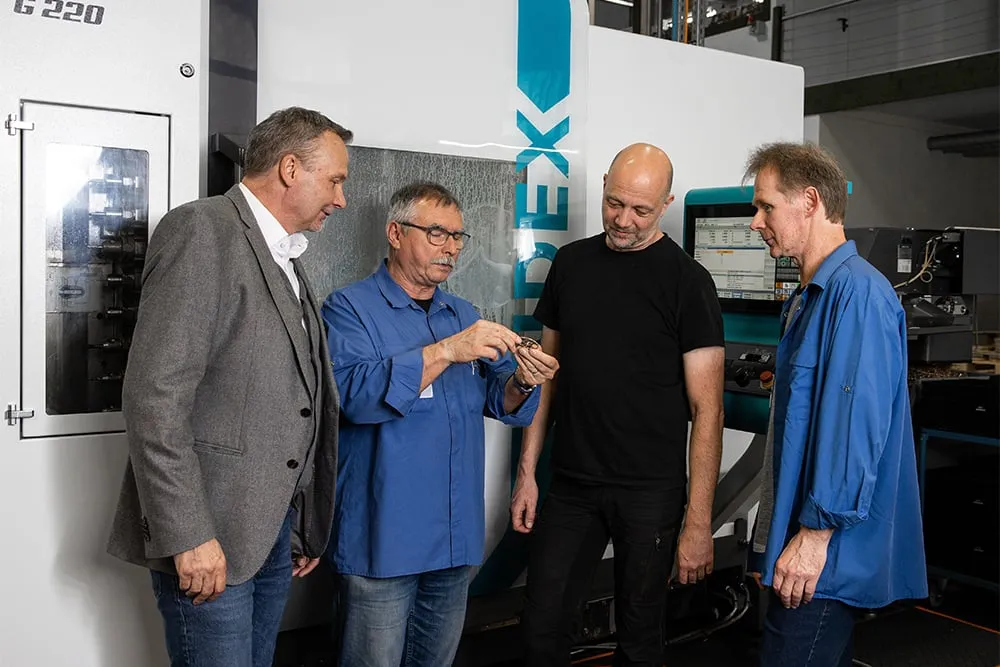
SAM GmbH (Singapore Aerospace Manufacturing) specialises in the development and manufacture of high-quality components for the aviation and aerospace industries. For almost forty years, the Bad Tölz-based company has relied on precision tools from Paul Horn GmbH to machine sensitive components. Alongside tooling solutions for grooving, internal turning and gear forming, it has now opted for the HORN hobbing system. The Bavarian manufacturer is confident that switching to gear skiving and investing in an INDEX turn-mill centre will deliver maximum process reliability.
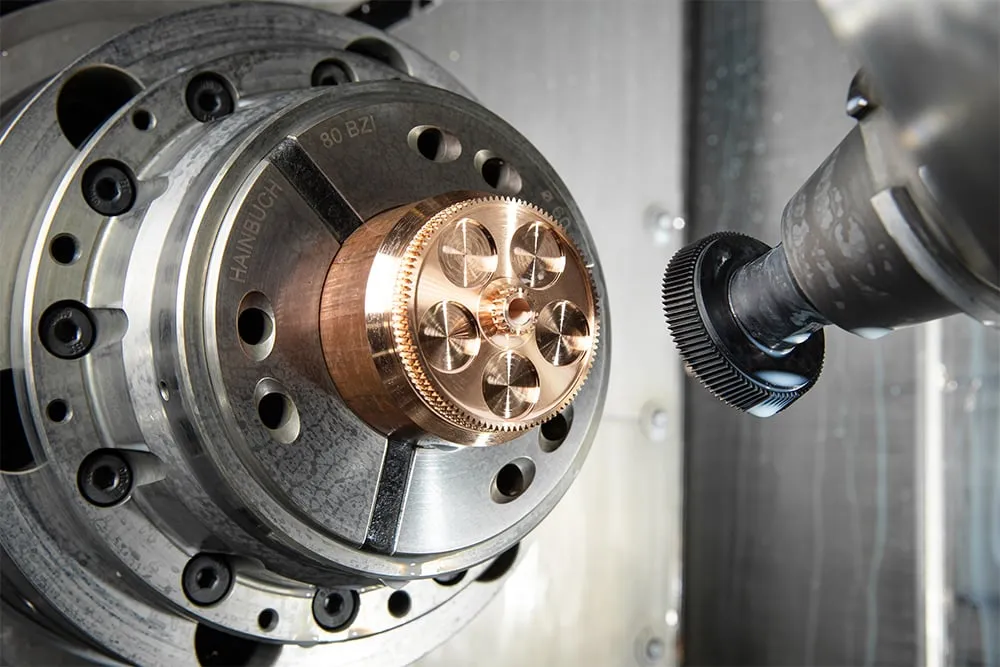
For more than 40 years, SAM GmbH has stood for stability, quality and flexibility. The company develops and manufactures a range of components for the aviation and aerospace industries, particularly actuators and valves, as well as complete assemblies for hydraulic applications and flight controls for various aircraft types. The actuators control valves for temperature regulation and oxygen, air, fuel and water systems. The range includes single- and dual-motor actuators, as well as modulating actuators. Dual-motor servomotors, for example, are used to close fuel supply valves where maximum safety is required. At the heart of each actuator is a bronze-alloy gear with a diameter of approximately 60 mm.
“In the past, production of this gear was mainly outsourced, but we decided to bring it in-house to gain greater flexibility and supply chain independence,” says Herbert Krischkowksi, Head of Special Projects at SAM GmbH. “With the existing machines, gear forming with a shaping unit was the only remaining option for producing external gears with a module of 0.5. Given our high volumes, this process would not have been cost-effective compared with outsourcing. Production time would have been too long, and the maintenance costs of a shaping unit would have further increased component costs.”
Erwin Wagner, Head of Tool Planning, adds: “The shaping units need to be serviced at least every six months when used continuously, which involves considerable expense.”
New turn-mill centre
The SAM GmbH team decided to invest in a new turn-mill centre to produce the gears by hobbing. “We did not yet have a lathe with a milling spindle in our machine fleet,” explains Erwin Wagner.
“The machine’s flexibility, together with the machine tool builder’s advice and service, ultimately led us to choose INDEX and its G220 turn-mill centre. We also purchased the hobbing cycle and hobbing tool with the machine. HORN and Michael Götze, our contact at the tool manufacturer, designed the tooling.”
“It was the right choice, as in-house production saves us several euros per part,” says Herbert Krischkowski. “The hobbing tool in use is not solid, but features an exchangeable head system with a highly precise interface. During the process, the gear teeth are cut in four tool passes: three roughing passes and one finishing pass at a reduced feed rate. The production time for gear skiving is around 20 seconds. We were impressed not only by this short production time, but also by the quality of the teeth.”
HORN hobbing system
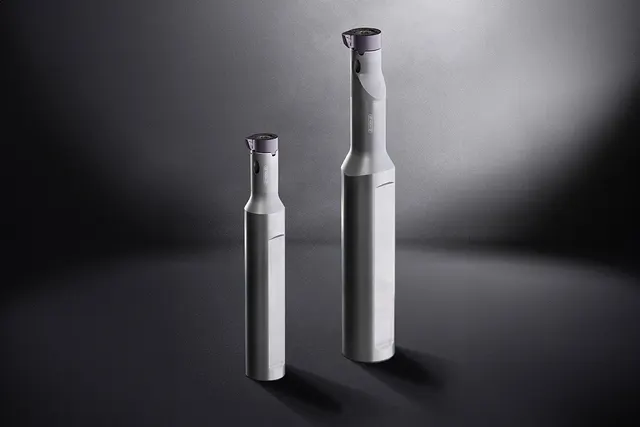
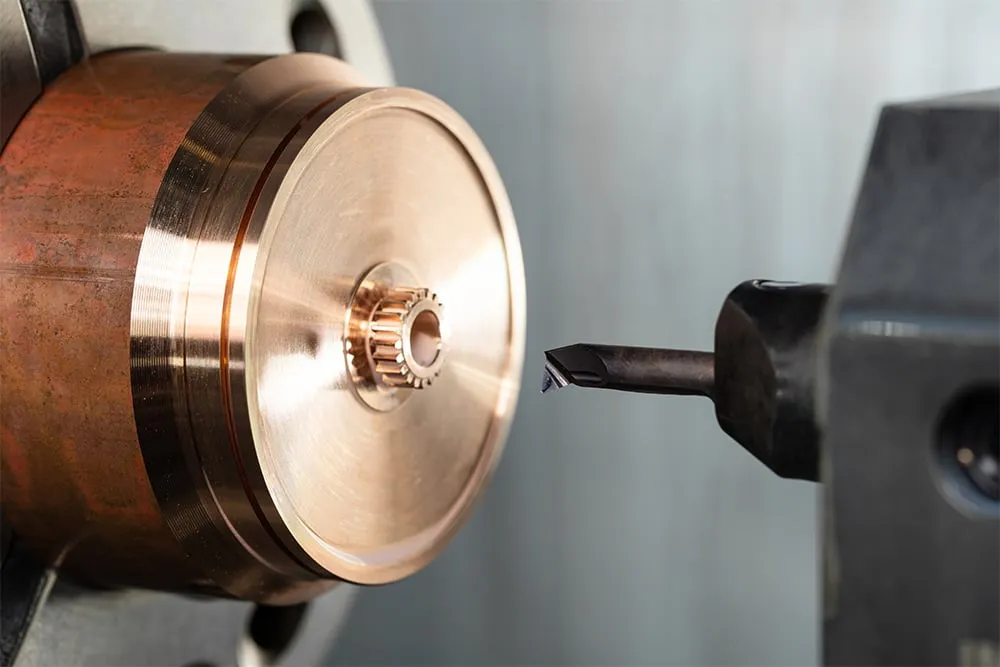
The HORN hobbing system comprises cylindrical or conical tools for modules from 0.5 to 2. The solid-carbide monobloc version is available in diameters of up to 20 mm and in a slim design. These tools are used for small modules and small parts, preferably where a slender shank is needed because of the risk of collision. Cutting materials and coatings suited to the application enable high surface quality on the workpiece.
For tool diameters above 20 mm, exchangeable-head hobbing tools are used. Thanks to the precise interface, the cutting head can be changed easily in the machine without removing the toolholder. The carbide toolholder ensures high rigidity, wear resistance and accuracy. For larger modules, HORN uses toolholders with indexable inserts. For the WSR tool type in particular, HORN offers the option of positioning the internal coolant supply either in front of or behind the cutting edge. This means that, depending on the application, blind holes, through-holes or stepped holes can be machined with the appropriate cooling.
Other HORN tools
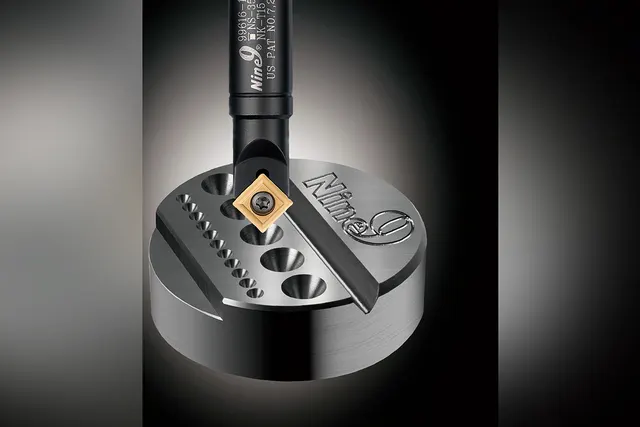
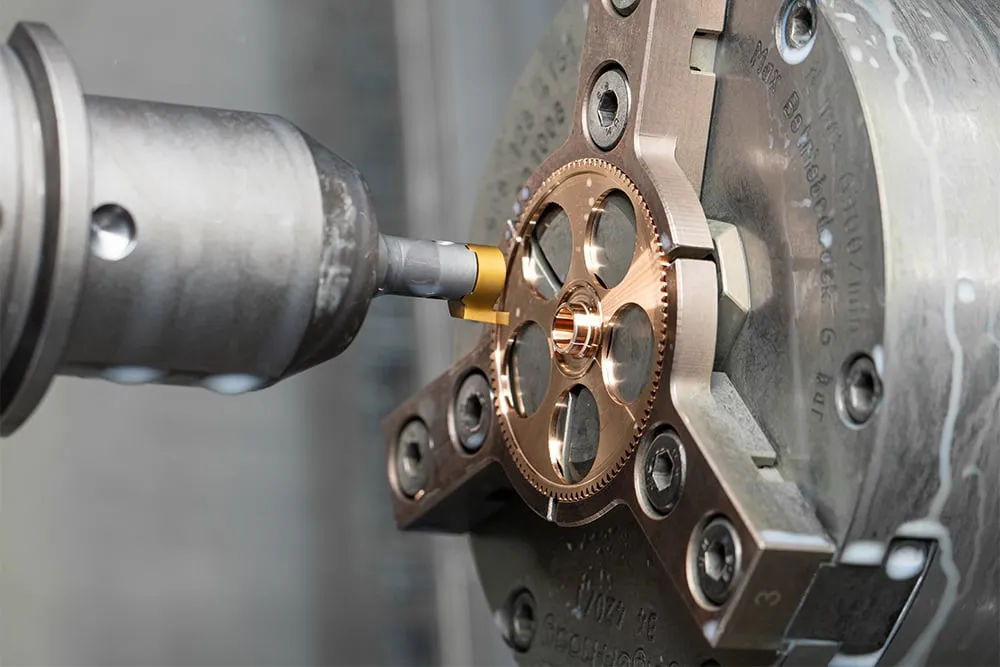
Other HORN tools are used to manufacture these gears. “Hobbing is not an option for producing an external gear at the front of the part, so an S117-type cutting insert is used,” explains Michaël Götze. “During the process, the tip diameter and clearance are first pre-turned at the end of the gear. The conical insert is precision-ground to a special shape and has two teeth. The first tooth acts as a pre-cutter, while the profile of the second tooth matches the nominal profile of the required gear tooth. In operation, the tool cuts one tooth at a time, in axial movements at a feed rate of 0.1 mm per pass. The main spindle then indexes by one tooth and repeats the indexing process until the gear teeth are complete. The production time for the teeth is around one minute.”
SAM also relies on its range of HORN tools for demanding turning operations. Two different Mini tools are used on the gear. The first tool, with a cutting width of one millimetre, turns the clearance of the small gear. The second Mini tool turns an axial cavity at the rear of the part. “The recess is unusual because it has a tight tolerance over a length of just two millimetres. The tool delivers high accuracy and process reliability here. A Supermini boring tool is used to bore the inside of the central hole,” concludes Erwin Wagner. “This project has been a success across the board. The implementation by INDEX and HORN was excellent. The tools and service have once again shown us why we have relied on HORN tools for decades.”
Een zakelijke vraag aan Hartmetall-Werkzeugfabrik Paul Horn GmbH? Get in touch
Companies in this story
Keep following this
Get an email when a new story is published. No account needed.
- ThemePrecision and productive machining
- SubjectTools
- CompanyHartmetall-Werkzeugfabrik Paul Horn GmbH