Why you should reconsider a bending cell
Texte : Valérie Couplez Photos : iStock
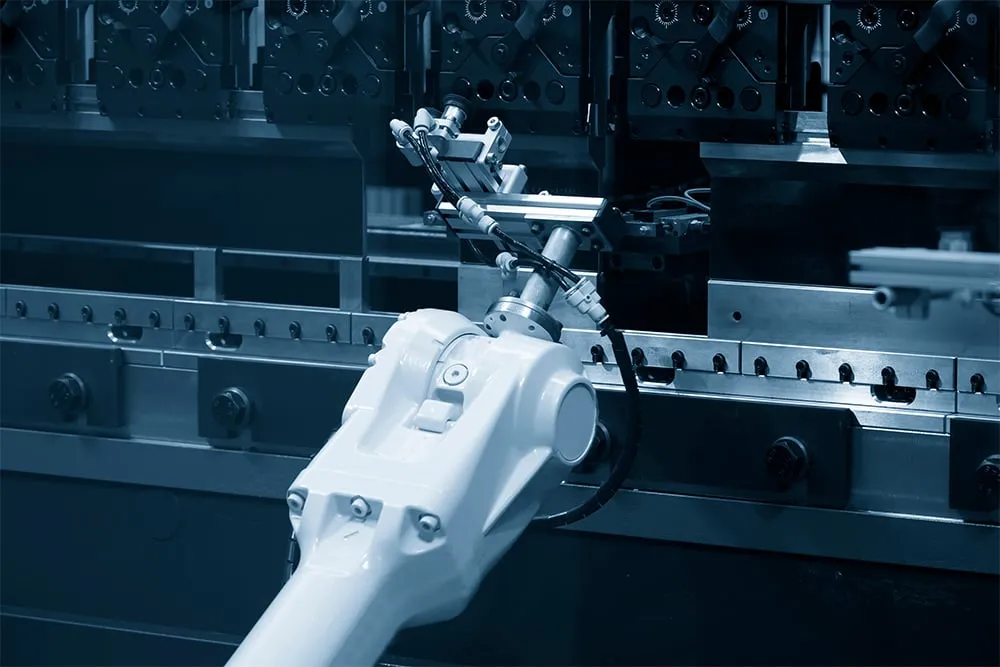
“We don’t make large batches. Automation isn’t for us.” Does that sound familiar? Yet there has never been a better time to reconsider this argument. Not least because it is difficult to find new workers. The software that controls these bending cells has also become much more accessible. In other words, you don’t need a degree in advanced mathematics to generate the programme. It is also fast enough to keep changeover times down, which means small batches are increasingly within the reach of the bending robot too.
Robotic bending is nothing new. In the past, batches had to run to thousands of parts to justify such an investment. But those days are gone. Take our word for it. Given the shortage of new employees, the most serious brake on growth for most metalworking companies, businesses would already be more inclined to move in this direction, even without technological advances. But technology has not stood still either. The software that controls bending cells has become far more sophisticated. The result? Programming can be quicker and easier. If a part is produced regularly, it can deliver a good return on investment even in batches of just ten.
Everything starts with the bending software
In the past, the bottleneck really lay in controlling the cell. The operator had to programme the robot’s movements and the press brake’s movements separately. If a collision occurred with a component along the way because the robot arm’s movements had been incorrectly estimated, everything had to be started again from scratch. Programming therefore had to be entrusted to an experienced press brake operator who understood exactly how a robot moves.
The programming software currently on the market eliminates all these complications. Everything is now done within the bending software itself. There is less and less programming involved, and more configuration. The software now generates the programme. Simulations then make sure everything runs without collisions. Simply press the button and start bending. Everything is right from the very first bend. Integrated angle measurement guarantees this.
Ever greater autonomy
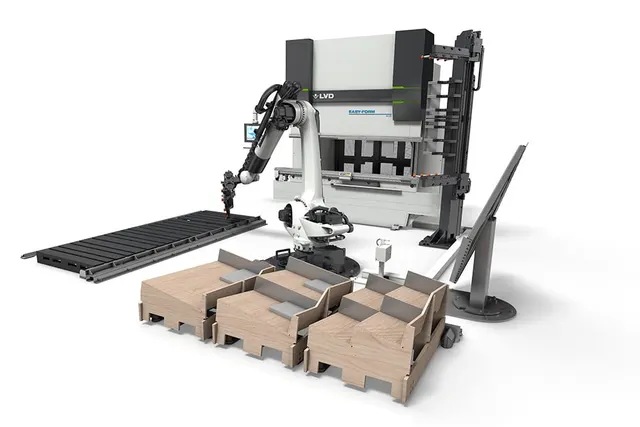
The robot does not necessarily perform its bending work faster than a human operator. Quite the opposite. But it can make up for this “lost” time by continuing to work at night or at weekends. And it does not get ill. What’s more, it provides an extra pair of hands that is almost impossible to find in today’s labour market. Bending-cell manufacturers have also worked on making their solutions more flexible. In addition to tool changers, various grippers are now available to pick up different parts correctly, using pistons, clamps, magnets and more. This development increases the autonomy of a bending cell. It is also a requirement in the Western European market. Batches are getting smaller and smaller. The thousands of parts mentioned above are the exception rather than the rule. So the technology needs to adapt to a new part in no time at all. That technology is now available.
Group parts more intelligently
Have we reached the end of our troubles? No. For the most complex parts, an experienced operator can still make a difference. The bending software can help with this too. It is smart enough to want to learn. What’s more, the focus is increasingly shifting beyond a single product. After all, there are still savings to be made by grouping certain parts more intelligently. By adjusting the sequence of your bending orders, you can reduce the number of tool changes, and therefore changeover times, even further. With a little ingenuity, you can halve changeover times. This calculation can be difficult even for the most experienced professional, but it is child’s play for bending software with all its computing power.
Question about this story? Ask your question
Keep following this
Get an email when a new story is published. No account needed.
- ThemeMetal forming and joining
- SubjectSheet metalworking