Gas nozzles for MIG/MAG welding torches
Texte : Valérie Couplez Photos : iStock
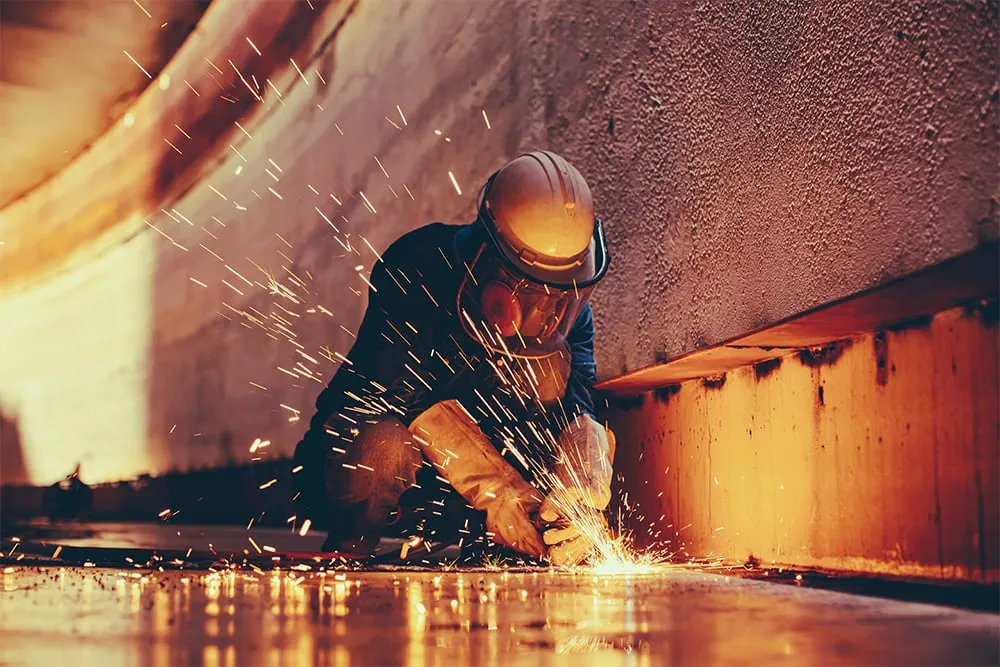
MIG/MAG welding is a demanding process. Both the operator and the material are pushed to their limits, making it all the more important to use the right tools. The welding torch and its wear parts deserve particular attention. These parts are very close to the process and must withstand heat and weld spatter for as long as possible. The gas nozzle is perhaps especially deserving of attention, as it is often wrongly used as a hammer as well as serving its actual purpose.
The gas nozzle’s job is to distribute the shielding gas evenly and in a laminar flow, ensuring the best possible protection of the weld area and the fastest possible dissipation of heat. As MIG/MAG is an arc welding process, both intended and unintended short circuits always produce more or less weld spatter, which sticks to the inside and outside of the gas nozzle. Specially coated nozzles for MIG/MAG welding torches can significantly reduce this unwanted effect and thereby ensure a longer service life.
Materials and properties
Every gas nozzle for MIG or MAG welding is made largely of copper or a copper alloy. Copper is an excellent conductor of heat, is easy to machine and is nevertheless highly robust. The cooler the nozzle, the less spatter adheres to it, as the spatter does not stick as firmly, is easier to remove and does not penetrate as deeply into the material. This improves functionality, service life and ease of maintenance. Gas nozzles are available in pure copper or brass, as well as with coatings such as nickel. The nickel coating acts as a barrier layer, preventing weld spatter from burning on or sticking to the nozzle. Nickel also reflects not only light but heat, reducing heat absorption during the welding process. Highly polished nickel-plated gas nozzles are even available.
Preventing weld spatter from sticking
Gas nozzles must be cleaned regularly to ensure a good laminar flow of gas. A special cleaning rod is recommended for this purpose. However, if burnt-on weld spatter builds up, it is time to replace the nozzle. Otherwise, obstructions will form in the shielding-gas flow path. In a gas nozzle where particles have built up, the gas flow is restricted and a vortex forms downstream. This turbulence can draw in air from the atmosphere and contaminate the gas. The result is pores and black marks on and beside the weld due to oxidation. The coating material determines how quickly weld spatter builds up, or how effectively its properties prevent spatter from sticking. In any case, a well-adjusted welding process that produces as little spatter as possible is the basis for a long service life for wear parts. You can also prepare your gas nozzles before welding to protect them against burn-on, for example by spraying them with a ceramic spray or dipping them in anti-spatter paste.
Push-fit or screw-on?
The answer is simple: it depends on the wear-part system used by the welding torch series in question. Push-fit nozzles have a larger contact area for heat dissipation than screw-on nozzles. They are also fitted with a locking ring that holds the gas nozzle in place once it has been pushed onto its seat. Of course, a MIG/MAG gas nozzle must fit in the same way at any temperature. The locking ring or a locking spring safely accommodates temperature-related differences as the material expands or contracts. This keeps the gas nozzle securely in place on its seat at all times.
Shape: a matter of requirements and accessibility
Every weld has its own requirements when it comes to the shape of a gas nozzle. Some tasks call for good access to the workpiece, while others require broad gas coverage. Compromises are often necessary. The wider the front of the gas nozzle, known as the nominal width (NW), the wider the gas shield. If access to the workpiece is very difficult, or the joint to be welded is in a narrow gap or even a corner, so-called narrow-gap gas nozzles or nozzles with a 45° angled front can make the job easier. The most important thing is to achieve optimal gas coverage. Choosing the wrong gas nozzle can easily result in insufficient shielding-gas coverage. If the workpiece is difficult to access, you can choose a gas-nozzle shape that still allows you to produce a high-quality weld. Today, there is a specialised nozzle for almost every access challenge.
Question about this story? Ask your question
Keep following this
Get an email when a new story is published. No account needed.
- ThemeMetal forming and joining
- SubjectWelding