Perfectly aligned weld seams every time with robotic welding
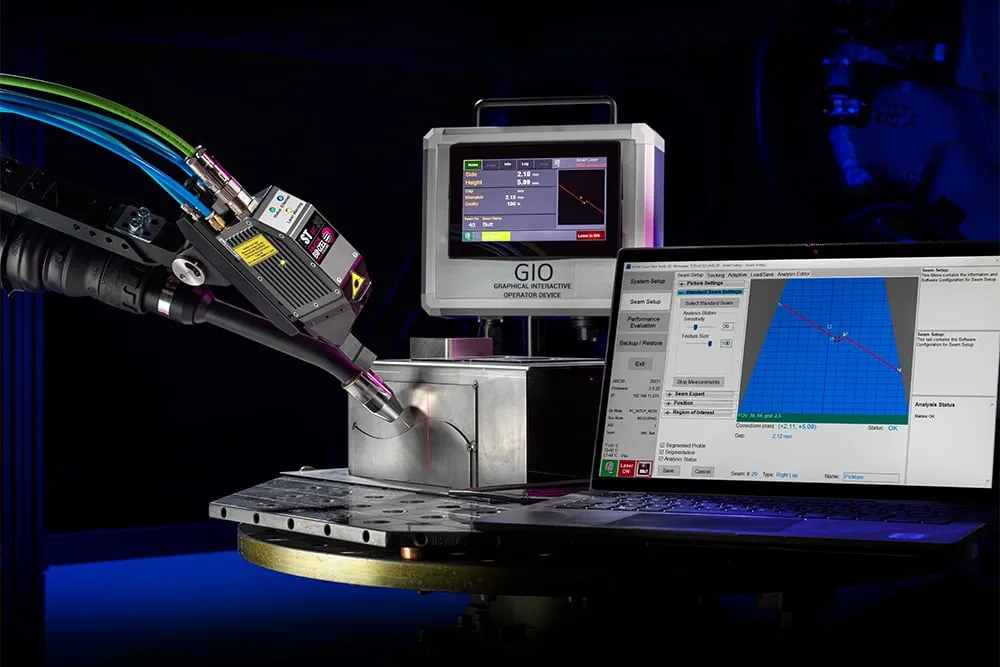
Cost-effective automated welding means every weld seam must be perfectly aligned. The right technology ensures that component tolerances are detected and compensated for. ABICOR BINZEL’s iSENSE TRACK ARC series seam-tracking sensors are experts in this field, acting as the robot’s eyes.
ABICOR BINZEL’s iSTR ARC seam-tracking sensors detect even the smallest deviations on the workpiece and provide the positioning system or welding robot with up-to-date data on the position of the seam to be welded. The system then adjusts the welding torch path in real time. These sensors can be used to compensate for thermal distortion and dimensional deviations that occur during component preparation. All seam-tracking sensors in the iST ARC series operate on the principle of laser triangulation: the sensor projects a laser line onto the workpiece surface, and a camera inside the sensor housing, the CMOS camera, records the reflection. Image-processing algorithms evaluate the camera signals and send information about the position and condition of the seam to be welded to the control system of the positioning system or welding robot.
Image processing inside the sensor housing
With iST ARC seam-tracking sensors, all image-processing technology is integrated into the sensor housing. This means no additional computer is required. It saves space: the “break-out board”, which provides the interface between the sensor housing and the positioning system or robot, can be easily integrated into the control cabinet.
Power and data over a single cable
Power supply and data communication between the sensor housing and the interface board take place over a single connection cable. This keeps the number of additional interfaces, and therefore potential sources of error, to a minimum.
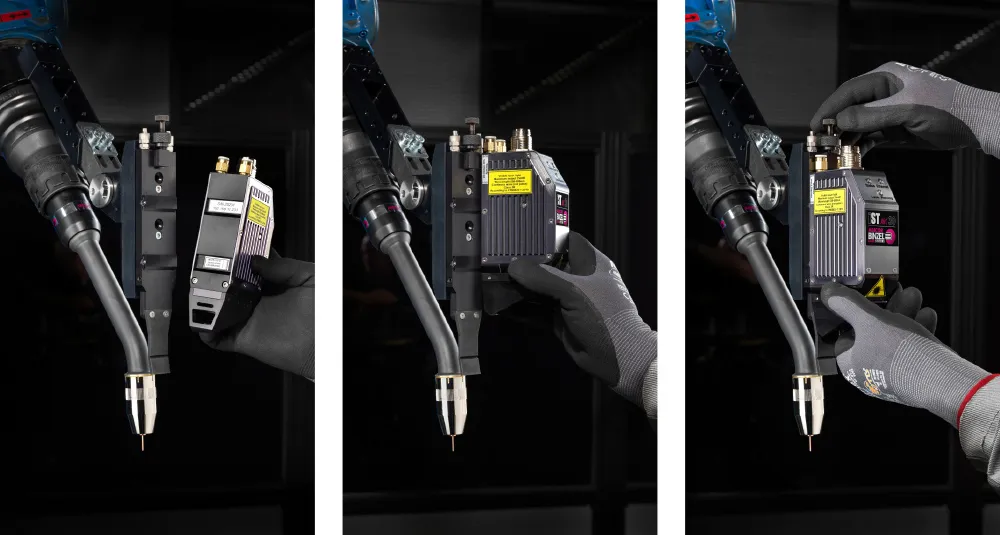
Assistance system for easy installation
The optional, compact and robust GIO (Graphical Interactive Operator Device) is a useful and practical feature. It allows the necessary settings to be adjusted while standing right next to the welding robot.
Automatic laser intensity adjustment
Automatic Gain Control automatically adjusts the laser intensity, camera shutter speed and other parameters. This greatly simplifies the setting of welding parameters and prevents suboptimal settings.
Easy maintenance and repair
The iST ARC is easy to maintain and repair. The sensor housing can be replaced without tools and, thanks to the dovetail flange, positional repeatability is very high. If necessary, the internal protective glass for the laser aperture and camera can be replaced directly on site.
Offline service for optimisation
The performance of your iST ARC installation can be improved through offline optimisation: you send us the recorded information about the weld seam, and we send back an optimised set of parameters. This can significantly reduce downtime and costly interventions.
The iST ARC series seam-tracking sensors at a glance:
- cover a wide range of applications, with a horizontal field of view of 15 to 50 mm;
- track butt joints with a minimum gap of 0.1 mm, depending on the sensor model;
- require no additional external processing computer, thanks to image processing directly inside the sensor housing, saving space in the electrical cabinet;
- can be used with all common metals, such as steel, stainless steel and aluminium;
- enable reliable weld seam tracking with flexible image-processing algorithms, including for curved weld seams and multi-pass welding;
- reduce rework costs and rejection rates in automated MIG/MAG and TIG welding;
- can be easily set up and operated directly in the welding cell using a compact and robust control unit;
- are equipped with protective glass and a “crossjet” to protect the optical components, camera and laser, from welding-process contamination;
- are compatible with most brands of robot and PLC-controlled machine.
Question about this story? Ask your question
Keep following this
Get an email when a new story is published. No account needed.
- ThemeMetal forming and joining
- SubjectWelding